

Austria Work Visa: How Non-EU Workers Can Get a Job
Non-EU workers usually need a job offer from an Austrian employer before they can get an Austria work visa. The main route for skilled workers is the Red-White-Red Card, and other key workers need at least 55 points on the official points system. Very highly qualified applicants need 70. Check the current rules on the official migration portal before you apply.
Last checked 8 November 2026. Rules and amounts change, so confirm them on the official pages linked below.
Which Austria work visa route fits you
This Austria work visa guide covers Austria only. Other countries use different permits, points and offices, so do not apply the figures here to a job elsewhere. The Red-White-Red Card is Austria’s points-based permit for skilled non-EU workers, but it is not the only route. Your qualifications, your job and whether you studied at an Austrian university decide which route fits.
Think of the routes as different doors with different keys. Reading the table below before you fill in any form saves time. Many applicants start the wrong application and lose weeks.
The main permits for an Austria work visa
Most people who ask about an Austria work visa are choosing between a few routes. The table below shows who each one suits and where to confirm the details.
| Route | Who it suits | Where to confirm |
|---|---|---|
| Red-White-Red Card, other key workers | Skilled workers outside the shortage lists who reach 55 points, the fixed minimum gross salary and pass a labour market test | official German page on Other Key Workers |
| Red-White-Red Card, very highly qualified | Applicants with at least 70 points, who may enter Austria first on a job-search visa | OeAD card page |
| Red-White-Red Card, graduate route | Graduates of Austrian universities who get a matching job offer within twelve months of graduating | official graduate route page |
| EU Blue Card | Highly qualified workers; I did not verify its rules for this guide | Official migration portal |
| Seasonal permit | Seasonal work in tourism and farming; I could not confirm its conditions from an official page | Official migration portal |
The table is a starting point, not a decision. Each official page sets out the exact rules, and those rules can change. Read the page for your route in full before you act on any figure here.
Why an Austria work visa usually starts with a job offer
For most routes, the job comes before the Austria work visa. The Red-White-Red Card for other key workers requires a labour market test, so the authority checks whether the job could be filled locally. Your employer takes part in that process.
This is the most important point in this guide. Find a real job with a real employer first, then check which route matches it. Do not pay for a permit before you have a written offer, because the case depends on one.
Who this Austria work visa guide is for
This guide is for non-EU workers who have skills, a recognised qualification or a realistic prospect of an Austrian employer. It explains the rules for an Austria work visa in plain terms and points you to official pages for the figures. It does not replace the official forms or advice from the authority that decides your case.
Who this is for: signs an Austria work visa is realistic
- You have a trade, a profession or a university degree that matches a job in Austria.
- You have a written job offer, or you are applying to employers who could make one.
- Your job is in an occupation on the official shortage lists, or you can reach the points threshold.
- You can meet the salary minimum for your category, which the official page sets out.
Who this is not for: signs you need a different Austria work visa route
- You plan to arrive without a job and find work once you are there.
- You want to study first and then work, because student rules are separate and I have not covered them here.
- You are hoping for a visa through an agent who promises a guaranteed job.
- You are a citizen of an EU, EEA or Swiss country, who has different rules that I have not covered here.
Austria work visa exceptions: graduates, family and seasonal workers
Some people follow different rules. Graduates of Austrian universities can use a route with no points system and no labour market test. It works only if the job matches their studies and the offer arrives within twelve months.
Family members have their own conditions, covered later in this guide. Seasonal workers follow a separate permit with its own limits. Choosing the wrong route is one of the most common reasons an Austria work visa is delayed.
The Red-White-Red Card for skilled workers on an Austria work visa
The Red-White-Red Card is the main points-based route for skilled non-EU workers. It is not one permit but a group of categories, and each has its own threshold. Choosing the right category is your first decision, and it shapes every document you gather afterwards.
What the Austria work visa card allows and how long it lasts
The card lets you work in Austria under the conditions set for your category. The official OeAD page explains the card in English and German, so it is the best place to check what it allows. I did not confirm validity periods from an official source, so check them there before you plan your move.
Read the conditions carefully, especially the rules about which employer you may work for. A card that suits one job may not suit a different job. Ask the authority before you change employer.
The main Austria work visa categories
- Other key workers: 55 points, a fixed minimum gross salary and a labour market test.
- Very highly qualified workers: at least 70 points, with the option to enter first on a job-search visa.
- Graduates of Austrian universities: no points system and no labour market test, if you get a matching offer within twelve months.
- Shortage occupations: jobs on the official lists, covered in the next section.
The categories overlap in some cases. A physician, for example, may fit a shortage list, while a graduate of an Austrian university may fit the graduate route. Check each official page, then pick the category with the clearest path.
The EU Blue Card is a separate permit. I did not verify its rules for this guide, so compare it on the official pages before you choose.
Shortage jobs and the Austria work visa points system
Austria publishes lists of shortage occupations. A job on the list can change your route for an Austria work visa, but it does not remove every requirement. The points system adds another layer, so you need to understand both to judge your chances.
How the Austria work visa shortage list works
There are two lists. The Austria-wide list applies anywhere in the country. The regional list applies only in the provinces named beside each job. For example, dentists appear on the regional list for Upper Austria, so that job counts only if it is in Upper Austria. Physicians appear on the Austria-wide list.
Check both lists on the official pages, because the year of each list was not shown on the pages I read. Read the current Austria-wide shortage list and the regional shortage list before you rely on either one.
Save a copy of each list page with the date you read it. If the authority later asks why you believed your job qualified, you can show what you checked and when.
How points count towards your Austria work visa
For other key workers, the official threshold is 55 points. For very highly qualified workers, it is 70 points. The official page sets out the points factors, but I did not confirm how many points each factor gives. Use the points information on the official German page, not estimates from other websites.
When you score yourself, be honest. Count only the qualifications you can prove with documents, and only the experience you can show with employer letters or payslips. A score built on claims you cannot support will fail when the file is checked.
Why enough points is not a guarantee
Reaching the threshold does not mean you will get an Austria work visa. You still need a job offer, a salary that meets the minimum, a labour market test where it applies, and approval from the authority. A strong score can still fail when the job or salary does not fit the rules.
Think of points as the entry ticket, not the final decision. A high score with a weak job offer is usually a weaker case than a moderate score with a clear, well-paid job.
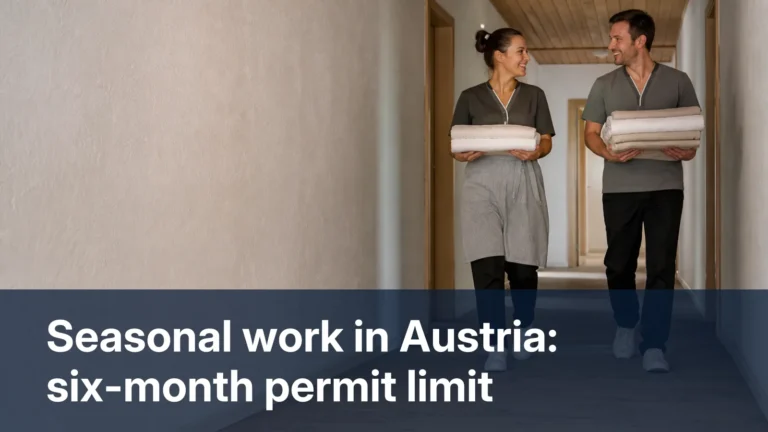
Seasonal work in Austria
Seasonal permits are used for work in tourism and farming. They are a separate route from the Red-White-Red Card, with their own limits on length and how you can stay. I could not confirm the permit length, quota system or application steps from an official page, so this section gives no figures.
Tourism and farming roles
Ask the employer which permit they plan to use, and check that the permit matches the job before you accept any offer. Seasonal roles in hotels, restaurants and farms are the ones this route covers.
Be careful with offers that describe a seasonal job as a path to settling in Austria. A seasonal permit is built for temporary work. An employer who promises long-term residence from a seasonal post is giving you a false picture.
What to confirm before you accept
Ask the employer in writing how long the permit lasts, who applies, and whether family members can come with you. I could not confirm these points officially, so check the official Red-White-Red Card plus page and the official migration portal for current seasonal rules before you commit.
Keep a copy of the written offer and any permit documents you receive. If the job ends early or the terms change, these papers show what was agreed.
German for your Austria work visa and job
German matters in two places: the visa rules and the workplace. The visa rules are clearer for family members than for workers, so the sections below separate the two.
When German earns points or is required
German can add points on the official points system, but I did not confirm how many points each level gives. Family members applying for the first time must prove German at A1 level, or complete Module 1 of the Integration Agreement. I could not confirm a pre-arrival German rule for the worker’s own card, so ask the authority directly.
If German could earn you points, prove your level with a recognised certificate. A statement that you speak German well will not count in the file.
Working in Austria with little German
Some workplaces use English, especially in technical and international teams. I did not verify which jobs do this, so do not assume yours will be in English. Ask the employer in writing which language the job needs, and what level they expect after your first months.
Plan for a gap. Safety notices, payslips, tax letters and everyday forms are often in German. Basic German helps you read these documents yourself.
Ways to start learning German early
Look for adult education courses in German near you. Ask about the price and the level, and take a placement test before you enrol. Online lessons can also help, so choose a course that lists its level clearly, such as A1 or A2.
Requirements: qualifications, pay and contracts
Requirements for an Austria work visa differ by category, so this section gives the rules for the graduate route and the general principles for other categories. Always confirm figures on the official page for your route before you act on them.
Getting foreign qualifications recognised
Some permits depend on your qualification, and some jobs require recognition of a foreign qualification. I did not confirm the recognition steps from an official source, so do not assume they are simple. Ask the authority which documents it needs, and start early if your job depends on it.
Keep original certificates safe, and order certified copies where your home country allows it. Translations may also be needed, so ask which translations are accepted before you pay for any of them.
Minimum salary rules for permits
Graduates must be paid the gross minimum salary that comparable Austrian junior graduates would locally receive. Other key workers must meet the fixed minimum gross salary set for their category. I did not confirm the exact figures for every category, so check the amount on the official pages before you accept an offer.
Ask the employer to state the gross salary in the contract, not only a net figure. The rules compare gross pay, and net amounts differ.
What a proper contract and fair offer look like
A fair offer is written. It states the gross pay, the working hours, the job title and the duties. It should also say which collective agreement applies, if any.
Ask for the contract before you pay for anything. Read it with someone you trust before you sign. For the graduate route, the official list of documents includes these items:
- An Employer’s Declaration under the Act Governing the Employment of Foreign Nationals, which the employer provides.
- Proof of a completed qualification at the set academic level.
- Health insurance covering all risks, either compulsory insurance or an equivalent policy.
- A passport photo sized 45 x 35 mm, no more than six months old.
Worked example (illustration only)
This example is illustrative only and uses no real figures. A welder with a trade certificate and several years of work wants to apply as an other key worker. She first checks the points factors on the official page, then gathers her certificates and employer letters.
She also confirms that her offered salary meets the fixed minimum for her category before she signs anything.
Finding an employer for your Austria work visa
Some Austrian employers sponsor foreign workers, but do not assume that every employer will. Employers provide documents such as the Employer’s Declaration for the graduate route. Ask in writing who pays which costs before you accept an offer, because a genuine employer should not charge you for the job itself.
Official job boards and public listings
Use official job boards and public employment listings as starting points, then check each employer on its own website. Search for the job title in German and English, because some listings use one language only.
Save the listings you find and note the date. Job adverts disappear quickly, and a written record helps you if the employer later changes the terms.
Company sites and legitimate recruiters
A real employer has a working website with a physical address, a contact phone number and a company name you can check. Recruiters can be genuine, but ask who they represent and whether they charge fees. If the recruiter cannot name the employer, stop there.
Ask the employer whether they have sponsored a foreign worker before, and what documents they usually provide. An employer who has handled a permit application will know the steps and the timing.
Preparing your CV and application
Keep your CV to one or two pages. List your qualifications, your work history and the job you want, and use plain language. Match your CV to the job advert, and be ready to explain your skills by phone or video if the employer asks.
Use short sentences and clear dates. Recruiters read many applications quickly, so make the key facts easy to find.
Spotting fake offers and checking an employer
Fake offers are a serious risk, and they target people who want an Austria work visa quickly. I did not find an official scam-warning page in my research, so the checks below are practical steps, not official guidance. Check current warnings on official Austrian government sites before you act.
Red flags: upfront fees, guaranteed visas and chat-app recruiters
- You are asked to pay a fee before you have a written contract.
- Someone promises a guaranteed visa or a guaranteed job.
- The recruiter contacts you only through a chat app and avoids phone calls or meetings.
- The salary is far above the market rate, or the job needs no skills at all.
Any one of these signs is enough to slow down and check. Two or more signs together mean you should stop sharing documents until you have verified the employer.
How to verify the company, the agent and the contract
- Find the company’s own website and check that the address and contact details match the offer.
- Ask the employer to confirm the job in writing from a company email address.
- Check that the salary meets the minimum for your category on the official page.
- For the graduate route, check that the employer will provide the Employer’s Declaration.
- If you are told a job is on a shortage list, check the official list for that province.
Call the company using a number you found yourself, not one the recruiter sent you. This simple step catches many fake offers.
Where to report a scam
If you think an offer is fake, stop sharing documents and do not send money. Report it to the Austrian police, and tell the police in your home country if you have already paid. Keep messages, emails and receipts, because they help any investigation.
Applying for an Austria work visa step by step
The process for an Austria work visa has several stages, and each one can slow your case. I could not confirm typical durations for each stage from an official source, so this section gives no timings. Plan for delays and start early.
From job offer to embassy visit
- Confirm that the job matches your route and that the salary meets the minimum.
- Gather your qualifications, your contract and any employer documents.
- Check the passport photo rules and the age limits on certificates.
- Submit the application through the route the official page describes, which may involve your employer.
- Attend the embassy or consulate visit if the authority asks for one.
Keep a checklist of every document, with the date it was issued. Dates matter for photos and police certificates, so a checklist stops you sending an old copy by mistake.
After arrival: residence card and registration
Check with the residence authority what you must do after you arrive, including any registration or residence card steps. I did not confirm these steps from an official source, so do not rely on a timeline from another website. Keep your passport and documents safe, and make copies of everything.
Typical delays and what slows a case down
- Missing documents: check the official list twice and send everything together.
- Old passport photo: the photo must be no more than six months old and sized 45 x 35 mm, so take a new one if yours is older.
- Old police certificate: for family members aged 14 or over, the certificate must be no older than three months, so order it close to your appointment.
- Unclear job or salary: ask the employer for a written offer that states the gross pay and the duties.
Mistakes that get applications refused
These errors cause trouble for many applicants. Each one below comes with a fix you can apply before you submit anything.
Mistakes about the category and the job
- Applying under the wrong category. Fix: compare the category pages side by side and choose the one that matches your qualification and job, not the one that looks easiest.
- Relying on a job that is not on the shortage list for your province. Fix: check the regional list for the exact province where the job is based.
Mistakes about documents and fees
- Sending an old passport photo. Fix: take a new photo sized 45 x 35 mm if the old one is more than six months old.
- Missing the twelve-month window for the graduate route. Fix: count the months from your graduation and get a matching offer in that time.
- Paying a fee that is not refunded. Fix: the application fee is not refunded if the application is refused or withdrawn, so confirm the offer and the documents before you pay.
Austria work visa costs to budget for
Costs depend on your route, your documents and the country where you apply. The table below lists common costs, with one official source per row. I have not added totals, because the amounts vary and several are not confirmed in my research.
| Cost | What to know | Source |
|---|---|---|
| Red-White-Red Card application fee | The fee is not refunded if the application is refused or withdrawn; check the current amount on the OeAD page | OeAD card page |
| Red-White-Red Card plus fee for family | Amount not confirmed in my research; check the current figure before you apply | official Red-White-Red Card plus page |
| Police clearance certificate | Required from family applicants aged 14 or over on a first application; must be no older than three months; the issuing fee depends on your home country | official Red-White-Red Card plus page |
| Passport photo | Sized 45 x 35 mm and no more than six months old; the cost depends on your local photo shop | official graduate route page |
| Health insurance | Must cover all risks; the premium depends on the policy you choose | official graduate route page |
| German test for family members | A1 level or Module 1 of the Integration Agreement; the cost depends on the course or exam provider | official Red-White-Red Card plus page |
| Proof of funds and living costs | No official figure confirmed in my research; check with the embassy or authority for your route | official Red-White-Red Card plus page |
A genuine employer should not charge you for the job. If someone asks for a payment before you have a contract, treat that as a warning sign. Ask for each cost in writing, and check it against the official page before you pay.
Bringing family on an Austria work visa
Some family members can join you on an Austria work visa, but the rules are strict and they differ by relationship. The official family pages set out who qualifies and what they must show. Read those pages before you plan a move with children or a spouse.
Spouse and children: who can join you
- Spouses and registered partners can apply for the Red-White-Red Card plus, provided the stay is over six months and they are married to or in a registered partnership with the sponsor.
- Unmarried children, including adopted and stepchildren, can join up to age 18.
- A spouse or registered partner must be at least 21 years old when the application is made.
- First-time applicants must show German at A1 level or complete Module 1 of the Integration Agreement.
- A first-time application made in Austria is possible only if the family member may enter without a visa.
Changing employer and extending the card
I did not confirm whether a card holder can change employer, or how the change works, so check the official migration portal before you accept a new job. The same applies to extending the card. Keep your documents up to date, and ask the authority what they need before your current permit expires.
The route to long-term residence
Long-term residence is a separate status with its own conditions. I did not verify those conditions for this guide, so do not treat it as automatic. Check the official pages for the current rules and ask the authority about the timing for your situation.
Next steps for your Austria work visa
- Check the current Austria-wide shortage list and the regional list, and confirm your job is on one of them if you rely on that route.
- Read the OeAD card page and choose the category that matches your qualifications and job.
- If you are a graduate, read the graduate route page and gather the documents on the list.
- Before sharing any documents, check the employer as described in the verification steps above, and ask for a written contract.
- If you plan to bring family, read the official Red-White-Red Card plus page and check the current German rule.
Frequently asked questions
How can I get a work visa for Austria?
Most non-EU workers apply for the Red-White-Red Card, and the route depends on the category. Other key workers need at least 55 points, a fixed minimum gross salary and a labour market test. Very highly qualified applicants need 70 points. Graduates of Austrian universities can use a route with no points system if they get a matching job offer within twelve months. Confirm the current steps on the official migration portal before you apply.
Can I get a job in Austria without speaking German?
I could not confirm an official rule that workers must speak German before they arrive, so treat this as an open question. The German A1 level I verified applies to family members applying for the first time, not to the worker’s own card. Many jobs may need German in practice. Ask the employer in writing which language the job needs before you travel.
What is the Red-White-Red Card?
It is Austria’s points-based permit for skilled non-EU workers. It has several categories, including other key workers, very highly qualified workers and graduates of Austrian universities. Each category has its own rules, so check which one matches your qualifications and job. Family members of card holders may apply for the Red-White-Red Card plus, which is a separate permit.
Which jobs in Austria give a visa?
The Austria-wide shortage list includes occupations such as physicians. Regional lists count only in the provinces named beside each job, for example dentists in Upper Austria. The list year was not shown on the pages I read, so check the current lists on the migration portal. Graduates of Austrian universities can also qualify without a labour market test if they get a matching offer within twelve months.
Do Austrian employers sponsor foreign workers?
Some do, but do not assume that every employer will. For the graduate route, the employer must provide an Employer’s Declaration, and the salary must meet the locally customary minimum for junior graduates. Ask the employer whether they have handled this kind of permit before, and which documents they will provide. I could not confirm salary figures for every category, so check the official pages.
How long does an Austria work visa take?
I could not confirm typical processing times for each category from an official source, so I will not give a figure. Timing depends on your category, whether your file is complete and which office handles it. Start early, prepare your documents in advance and check the current position with the official migration portal or the Austrian embassy.
Can I bring my family to Austria?
Some family members can join you. Spouses and registered partners can apply for the Red-White-Red Card plus, and unmarried children can apply up to age 18. A spouse must be at least 21 when the application is made. First-time applicants must show German at A1 level or have completed Module 1 of the Integration Agreement. Applicants aged 14 or over need a police clearance certificate no older than three months.
How do I know if an Austrian job offer is real?
Check the offer with official sources before you share documents or pay anything. Confirm that the salary meets the minimum for your category, and that the job matches a shortage list if you rely on that route. Never pay upfront for a job or a guaranteed visa. I found no official scam-warning page in my research, so check current warnings on official Austrian government sites.
Sources
- Sonstige Schlüsselkräfte (migration.gv.at)
- Rot-Weiß-Rot – Karte (OeAD)
- Graduates of Austrian universities and universities of applied sciences (migration.gv.at)
- Red-White-Red Card (OeAD)
- Red-White-Red Card plus (migration.gv.at)
- Application for a Red-White-Red Card plus (City of Vienna)
- Austria-wide shortage occupations
- Regional shortage occupations




One Comment