
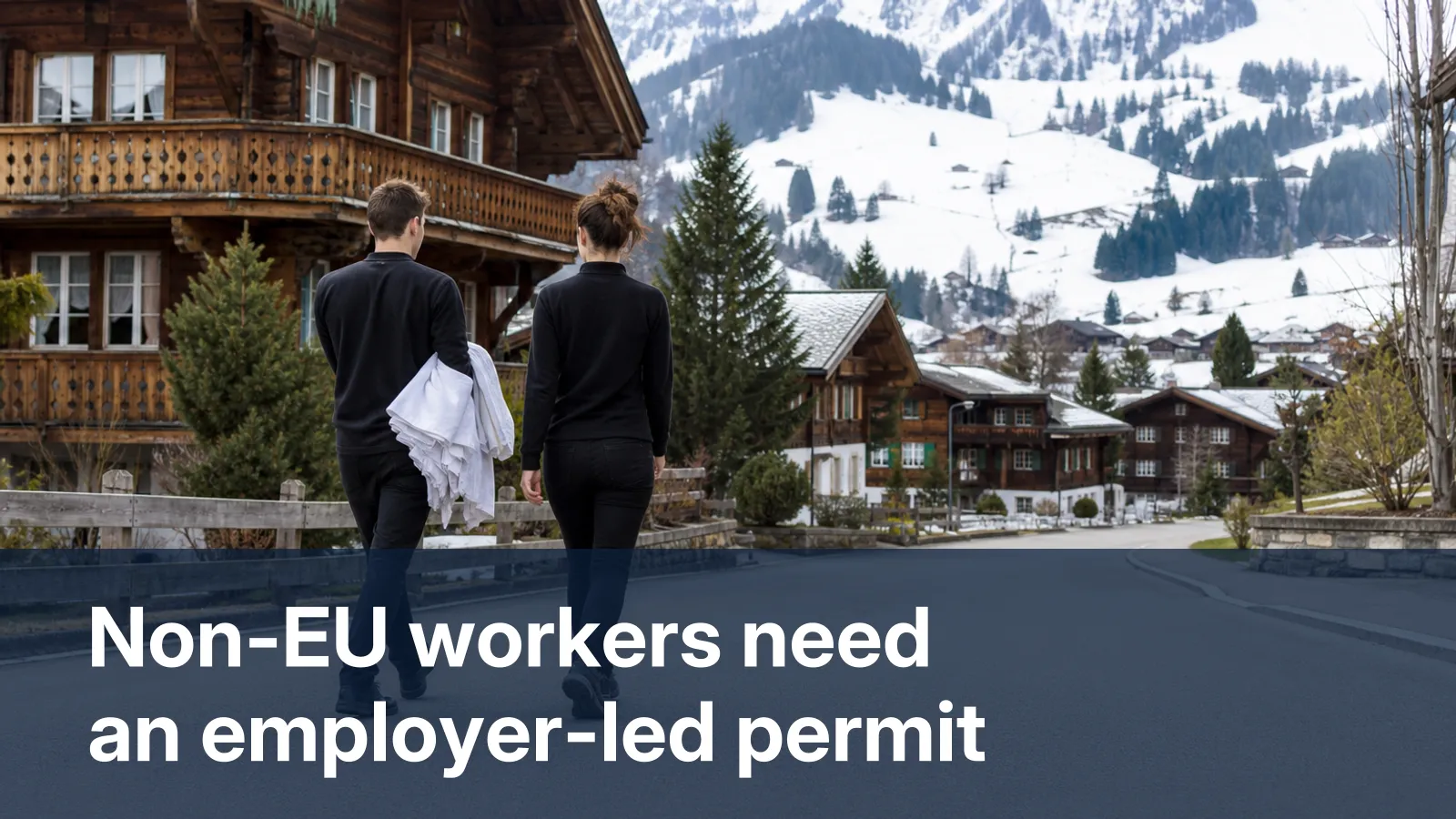
Seasonal Jobs in Switzerland for Foreigners: Who Can Apply
This article answers the eligibility question only. For the wider picture of visas and hiring, read our Switzerland work visa guide for non-EU workers.
Can Foreigners from Outside the EU Get Seasonal Jobs in Switzerland?
For a non-EU citizen, seasonal work is possible only through the normal work-permit route. The official pages reviewed do not describe a faster lane for ski resorts, hotels or farms. So treat every seasonal job in Switzerland for foreigners from outside the EU as a standard work-permit case.
Why EU and EFTA Citizens Get Different Rules for Seasonal Jobs in Switzerland
Switzerland is outside the European Union but has a free movement agreement with it and with the EFTA states. Under the notification process, EU and EFTA service providers can work in Switzerland for up to 90 effective working days a year. They must file a notification beforehand. The official SEM notification page sets this out, and it does not offer the route to people from other countries.
A Swiss employer can also hire foreign workers for up to three months by filing an online notification, not a permit. That page sits within the EU/EFTA section, though, and does not say that non-EU workers qualify. Do not assume it covers you.
Where Non-EU Applicants Stand for Seasonal Jobs in Switzerland
As a non-EU applicant, the employer leads the process, and only the employer can file the work-permit application. A firm job offer does not by itself give you the right to a permit. The employer must also meet conditions on precedence, qualifications and salary, and a quota place must still be free.
Eligibility for a non-EU seasonal worker usually depends on five things:
- your nationality, since EU and EFTA rules differ from third-country rules;
- the permit route the employer uses;
- whether the employer can show that no suitable Swiss or EU/EFTA candidate is available;
- whether your training and experience fit the profession;
- whether a quota place is still available that year.
No official page reviewed describes a seasonal or ski-resort category for non-EU nationals. Treat any claim of an easy route into a Swiss ski resort as unverified until you see it in an official source.
Permits Behind Seasonal Jobs in Switzerland for Foreigners
The official pages reviewed do not name a seasonal work visa for Switzerland. An agent who sells one should be treated with caution. Seasonal jobs in Switzerland for foreigners fall under the general rules. So the real question is which permit fits your nationality and job.
Short-Stay Permits for Foreigners Doing Seasonal Jobs in Switzerland
The short-stay L permit is described in the SEM free movement FAQ for EU and EFTA workers. It covers jobs up to 364 days, while the B residence permit covers jobs of at least one year or open-ended work. The SEM pages do not confirm these periods for non-EU seasonal workers, so read the terms of any permit you are offered.
The yearly ceiling matters too. The Federal Council kept the 2026 ceiling for qualified workers and specialists at 8,500, split into 4,500 B permits and 4,000 L permits. Around 52 per cent of the third-country quota was used by the end of September 2025. That is a snapshot, so check the current position before you plan. For more detail, read our Swiss work permit quota explained.
Whether a Summer Job for Foreigners in Switzerland Needs a Work Permit
For most non-EU nationals, yes. The Canton of Zurich explains that third-country nationals need a work permit from their first day of work. EU and EFTA nationals follow a different procedure, so the summer rules you read about may not apply to you.
Before you accept a summer offer, work through these steps:
- Confirm your nationality: EU/EFTA or third-country.
- Ask the employer which permit route they plan to use.
- Ask for the permit decision in writing before you buy travel.
- Check whether a visa applies to your country of origin, since the SEM overview says this depends on it.
Which Seasonal Jobs in Switzerland Accept Foreigners?
The official pages reviewed do not list seasonal jobs in Switzerland for foreigners, so no list can be given from them. What the rules do show is who can be admitted: managers, specialists and other qualified workers. That points to roles where your training matters more than the season.
The SEM overview says non-EU work permits are capped, and the cap depends on qualifications and occupation. The 2026 ceiling for qualified workers and specialists is 8,500, according to the Federal Council.
The SEM admission basis defines qualified workers mainly as people with a university or university of applied sciences degree and several years of work experience. It also says people with special training and several years of experience may be admitted, depending on the profession. It does not publish a full list. A seasonal post that needs little training is therefore harder to qualify for.
Hotels, Resorts and Farms: Sponsorship for Seasonal Jobs in Switzerland
Do hotels sponsor visas for seasonal jobs in Switzerland for foreigners? The official pages reviewed do not describe hotels as a sponsor category. The employer applies, and it must show that its search for a suitable Swiss or EU/EFTA candidate was unsuccessful and carried out in good faith.
The same process applies to resorts and farms on the pages reviewed, since none separates them out. A short contract is less attractive to an employer, because they carry the search, the paperwork and the risk of refusal. Ask early whether they will file.
- Will you file the work-permit application yourself?
- Can you show your search for a Swiss or EU/EFTA candidate?
- Which permit route do you expect to use, and for how long?
- Will the contract be in writing before I pay anything?
Be careful with any hotel or agent who asks for money first. The Local has reported that early versions of a fake job-offer scam mainly targeted hotel jobs and foreign nationals. That is a news report, so check the official federal notice before you rely on the detail.
Swiss Rules for Seasonal Jobs in Switzerland for Foreigners: Figures and Sources
The table below lists the rules a non-EU applicant must meet, with the figure or threshold and the official page it comes from. Check each source before you act, because rules and quotas can change between years.
| Rule | What the official page says | Source |
|---|---|---|
| Who files | Only the employer can file the work-permit application. | Canton of Zurich |
| Local search | The employer must show that no suitable Swiss or EU/EFTA candidate is available. | SEM overview |
| Priority groups | Swiss nationals, C and B permit holders and some other groups come first. | SEM admission basis |
| Qualifications | Managers, specialists and qualified workers only. Qualified usually means a degree plus several years of experience. | SEM admission basis |
| Yearly ceiling | 8,500 for 2026 for qualified workers and specialists: 4,500 B and 4,000 L. | Federal Council |
| Pay | Pay and conditions must match what is customary for the location, profession and sector. No fixed minimum is stated. | Canton of Zurich |
| Start date | The permit is needed from the first day of work. | Canton of Zurich |
| Registration | Due no later than 14 days after entering Switzerland. The page says work may only start after registration. | SEM overview |
| Visa | May be needed, depending on your country of origin. | SEM overview |
Two further conditions apply. SEM says Switzerland admits workers only when this serves its overall economic interests. For longer stays, authorities also weigh language skills and age.
How Long You Can Work on a Short-Term Permit
The dates on your permit decide the answer. The official pages reviewed give a length only for EU and EFTA workers. An L permit covers up to 364 days. Work of at least a year, or open-ended work, falls under the B permit.
For a non-EU worker, the sources do not confirm a set period for seasonal jobs in Switzerland for foreigners. Ask the employer and the cantonal migration office for the exact permit length in writing before you plan your travel or your rent.
If you graduated from a recognised Swiss university, you can stay for six months to look for a matching job. That is a separate status route, not a seasonal one.
Extension Limits and Status Changes
The official pages reviewed do not say how often a short-term permit can be extended for non-EU seasonal workers. Do not assume a summer contract can roll into a winter one on the same permit. Ask first.
The official pages reviewed do not describe penalties for staying beyond a permit. Treat any permit end date as firm, and check what happens with the cantonal migration office well before that date.
Do You Need German for Hotel Work?
The official pages reviewed do not set a German-language requirement for hotel work, so there is no official answer to give. The language a hotel uses day to day depends on its region and its guests. A resort in a French-speaking area may need French, while an international resort may use English.
The SEM admission basis says language skills are one factor authorities weigh for longer stays. It does not say a set level is needed to work, so do not treat it as a hiring rule.
Ask the employer which languages the team uses daily, and show any language certificate you hold. If the employer allows it, offer a short trial shift, because that shows your skills more clearly than a certificate can.
Accommodation in Seasonal Jobs in Switzerland
The official pages reviewed do not say whether seasonal jobs include accommodation. Whether staff housing is offered is an employer decision, so treat housing as something to confirm, not something to assume.
Get the housing terms in writing before you sign. Check whether housing is free, paid for, or deducted from your pay, and whether the deduction amount is stated. Deductions matter because pay must match what is customary, as the Canton of Zurich page explains. Vague housing clauses can lead to disputes over pay.
Do not count on housing being arranged before you arrive. Never pay a fee for a room the employer has not confirmed in writing.
Worked Example: A Non-EU Winter Hotel Applicant
This is an example built for illustration, not a real case. The figures come from the verified sources in this article, and the outcome is one plausible path, not a promise.
Example: a non-EU applicant with several years of hotel experience and a hotel training certificate receives a winter contract offer from a resort. Seasonal jobs in Switzerland for foreigners like this one follow the same checks as any work-permit case.
Checking Each Step of the Example
- Check nationality. As a non-EU applicant, the EU/EFTA notification route for up to 90 days does not apply.
- Check the qualification test. The employer must show the job fits a qualified profile. SEM ties that to a degree plus several years of experience, or to special training and experience for the profession.
- Check the local search. The employer must show that no suitable Swiss or EU/EFTA candidate is available.
- Check the quota. The 8,500 ceiling for 2026 applies to qualified workers and specialists, split into B and L places.
- Check pay. The offer must match customary pay for the location and sector. Ask for the exact figure in writing.
- Check language and housing. Confirm both in writing, since the official pages do not set them.
- Check timing. The permit must be in place before the first working day, and registration is due no later than 14 days after entry.
In this example the offer is a starting point, not a guarantee. A firm offer does not give the right to a permit, so the applicant should never pay for a guaranteed visa.
How to Verify a Seasonal Job Offer in Switzerland
Before you pay anyone or sign a contract, confirm that the employer and any agent are real. Checking seasonal jobs in Switzerland for foreigners costs nothing but a little time.
Red Flags in Easy Seasonal Visa Offers
- A promise of a seasonal visa or guaranteed permit, which the official pages reviewed do not describe.
- Fees for a permit said to be guaranteed.
- Requests for upfront payment before a written contract exists.
- A website that imitates a real or invented Swiss company, a pattern reported in the federal warning covered by The Local.
- Vague pay, hours or housing terms in the offer.
Checking Employers and Agents on Official Lists
- Ask for the employer’s full legal name, address and company number, then look them up in the official Swiss commercial register.
- Check that the website, email domain and address match the register. A new domain or a mismatch is a reason to stop.
- Ask which canton will handle the work-permit file, then visit that canton’s migration pages directly rather than through a link in the offer.
- Read the SEM overview of work permits yourself, and compare the employer’s claims with it.
- If an offer fails any check, report it to the police in your country and do not send money.
Frequently asked questions
Can foreigners work seasonal jobs in Switzerland?
Yes, but it depends on nationality. EU and EFTA service providers can be active in Switzerland for up to 90 effective working days a year after filing a notification beforehand. Non-EU and non-EFTA applicants need an employer-led work permit, and the official pages reviewed do not describe a seasonal route for them.
Can non-EU citizens work in a Swiss ski resort?
The official pages reviewed describe no seasonal or ski-resort category for non-EU and non-EFTA nationals. Any non-EU applicant would need an employer to apply for a work permit, show that no suitable Swiss or EU/EFTA candidate is available, and fit within the limited yearly quota. Treat claims of an easy route into a ski resort as unverified.
Is there a seasonal work visa for Switzerland?
The official pages reviewed do not name a seasonal work visa for Switzerland. The L short-stay permit is described for EU and EFTA workers, covering jobs of up to 364 days. A visa may still be needed alongside a work permit, depending on your country of origin, so check with Swiss representation in your country.
Do hotels in Switzerland sponsor visas for seasonal staff?
The official pages reviewed do not list hotels as a sponsor category. The employer must file the work-permit application and show that it could not find a suitable Swiss or EU/EFTA candidate. Ask early whether the employer will file, and walk away from any offer that asks for payment first.
How long can I work on a short-term permit in Switzerland?
For EU and EFTA workers, the short-term L permit covers jobs of up to 364 days, while the B permit covers at least one year or open-ended work. The official pages reviewed do not confirm these periods for non-EU seasonal workers. Read the dates on your own permit document, and check any extension with the cantonal migration office.
Do I need a work permit for a summer job in Switzerland?
For most non-EU nationals, yes. Work needs a permit from the first day, and the employer must file the application. EU and EFTA nationals can work for up to three months under an online employer notification, but the pages reviewed do not offer that exemption to non-EU applicants.
Sources
- Notification procedure for short-term work in Switzerland (SEM)
- FAQ – Free Movement of Persons (SEM)
- Third-Country Nationals (Canton of Zurich)
- Federal Council leaves third-country quotas for 2026 unchanged (admin.ch)
- Basis for admission to the Swiss employment market (SEM)
- FAQ – Working (SEM, Non EU/EFTA nationals)
- Working in Switzerland (SEM)

One Comment